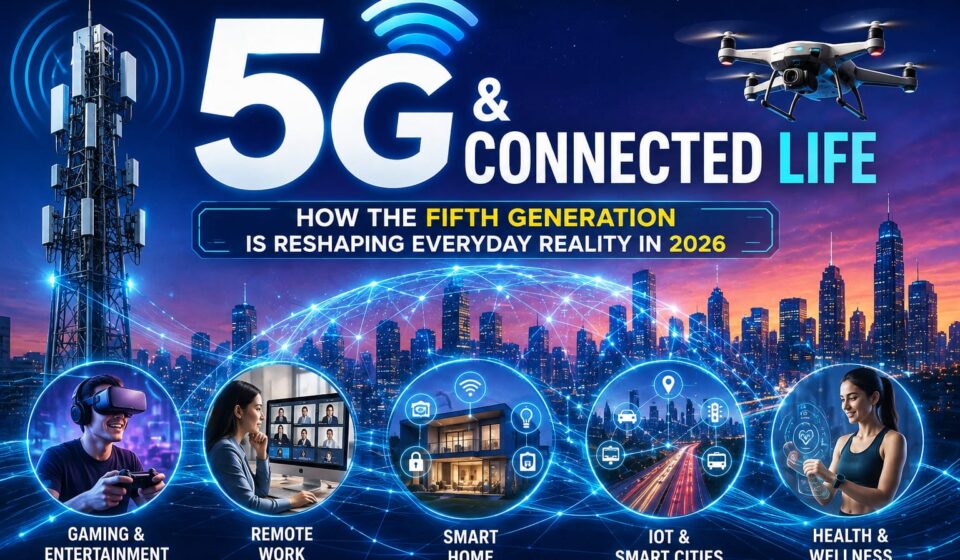

5G is the fifth generation of mobile networks, designed to deliver much faster speeds, far lower latency, and the ability to connect vastly more devices at once than 4G. In 2026, its real impact is less about “theoretical maximum speeds” and more about stable, low‑latency, high‑capacity connectivity that enables new experiences in streaming, gaming, remote work, smart homes, and the broader Internet of Things (IoT).aws.amazon+5
Below is a detailed, blog‑ready guide you can adapt or publish as‑is.
What Is 5G? (In Simple Terms)
5G is the latest global wireless standard after 4G LTE. It uses higher frequency bands, advanced antennas (like Massive MIMO), and smarter network design to provide:hpe
- Much higher data speeds – up to around 20 Gbps in ideal conditions, several times faster than typical 4G.hpe+2
- Ultra‑low latency – response times as low as ~1 millisecond in optimal setups, compared to tens of milliseconds on 4G.hpe+1
- Massive device capacity – support for over a million connected devices per square kilometer, crucial for dense cities and IoT.hpe+1
- Better reliability and consistency – more stable connections in crowded places like stadiums, airports, and offices.techtarget+1
In practice, this means faster downloads, smoother video calls, near real‑time interactions, and networks that don’t collapse when everyone is online at once.aws.amazon+1
Why 5G Matters More in 2026 Than Ever
By 2026, 5G coverage has expanded and networks have matured into “5G‑Advanced” versions that are more efficient and intelligent. The focus has shifted from marketing “gigabit speeds” to:greyb
- Network efficiency – handling more traffic without congestion.techularztrix
- Latency reduction – enabling real‑time applications like cloud gaming, AR/VR, and remote control systems.hpe+1
- Capacity management – supporting huge numbers of IoT devices in smart homes, factories, and cities.techularztrix+1
This makes 5G a backbone for the “connected life” rather than just a faster phone network.ituonline+1
5G and Entertainment: Streaming, Gaming, and Immersive Media
Streaming video and music
5G’s higher bandwidth and lower latency transform how we consume media on mobile and home networks:
- Ultra‑HD and 4K/8K streaming becomes smooth even on phones and tablets, with minimal buffering.techtarget+1
- Live events and sports can be streamed in higher quality with more camera angles and interactive features.circles
- High‑fidelity music and spatial audio services work better on the go, with quicker loading and fewer dropouts.circles
For creators and platforms, 5G enables richer mobile experiences: multi‑angle live streams, real‑time audience interaction, and higher‑quality user‑generated content.aws.amazon+1
Gaming: From consoles to the cloud
Cloud gaming is one of the clearest consumer benefits of 5G:
- Console‑quality games on phones and tablets via cloud services, with graphics rendered remotely and streamed to your device.circles
- Lower lag makes competitive and fast‑paced games feel more responsive, closer to playing on a local device.techtarget+1
- Cross‑device play becomes smoother, as 5G can handle high data rates and low latency for multiple players in different locations.hpeyoutube
In 2026, many gamers treat their phones and lightweight devices as “screens” for powerful cloud servers, thanks to 5G’s performance.circlesyoutube
AR, VR, and mixed reality
Augmented reality (AR), virtual reality (VR), and mixed reality (MR) rely heavily on low latency and high throughput:
- Immersive experiences like virtual tours, training simulations, and interactive storytelling run more smoothly on 5G.hpe+1
- Real‑time overlays for navigation, shopping, education, and entertainment become practical on mobile devices.hpe+1
- Social VR/AR spaces where people meet, collaborate, or attend events feel more natural with reduced motion lag and better video quality.hpe+1
5G and Remote Work: The Always‑Connected Office
Remote and hybrid work depend on reliable, high‑quality connectivity. 5G strengthens this in several ways:
Video conferencing and collaboration
- Higher‑quality video calls (including multi‑person HD calls) with fewer freezes and artifacts, even from mobile hotspots.hpe+1
- Real‑time collaboration tools (shared whiteboards, live document editing, design reviews) respond faster, making remote teamwork feel more “in‑person.”hpe+1
- Mobile offices – professionals can work from trains, co‑working spaces, or client sites with near‑office‑level connectivity.aws.amazon+1
Cloud‑first workflows
With 5G, more work happens directly in the cloud:
- Cloud desktops and apps load quickly and feel responsive, reducing the need for powerful local hardware.techularztrix
- Large file transfers (design files, datasets, videos) happen in seconds to minutes instead of hours.redempires
- AI‑assisted tools (real‑time transcription, translation, summarization) work more smoothly because data can be sent to and from servers with minimal delay.techularztrix+1
This makes location less of a constraint and supports truly flexible work models.aws.amazon+1
5G and the Smart Home: A More Connected Daily Life
Smart homes are one of the most visible parts of the “connected life,” and 5G amplifies what’s possible.
More devices, fewer bottlenecks
Traditional Wi‑Fi can get congested when many devices compete for bandwidth. 5G helps by:
- Supporting many simultaneous connections – cameras, sensors, lights, locks, appliances, wearables, and entertainment systems.circles+1
- Reducing lag for time‑sensitive tasks like security alerts, door locks, and automation triggers.hpe+1
- Improving reliability in households with heavy streaming, gaming, and work‑from‑home usage.techularztrix+1
Practical smart home use cases
In a 5G‑enabled home, you might see:
- Security and monitoring: multiple high‑resolution cameras streaming continuously to the cloud, with instant alerts and real‑time viewing from anywhere.circles+1
- Energy management: smart thermostats, lighting, and appliances that adjust based on usage patterns, pricing signals, and occupancy, all communicating reliably over the network.circles+1
- Health and wellness: wearables and home health devices that send data to apps or doctors in near real‑time, supporting remote monitoring and early warnings.hpeyoutube
- Entertainment hubs: seamless 4K/8K streaming, VR/AR experiences, and multi‑room audio/video synchronized without noticeable delay.circles+1
As more devices come online, 5G’s capacity and efficiency become critical to keeping everything responsive.ituonline+1
5G and the Internet of Things (IoT): From Gadgets to Smart Cities
IoT refers to the vast network of connected devices—sensors, machines, vehicles, infrastructure—that exchange data. 5G is designed to support IoT at scale.ituonline
Key IoT benefits enabled by 5G
- Massive device density: thousands to millions of devices per square kilometer, ideal for smart buildings, campuses, and cities.hpe+1
- Ultra‑reliable low‑latency communication (URLLC): essential for industrial automation, robotics, and safety‑critical systems.hpe+1
- Network slicing: operators can create virtual “slices” of the network optimized for specific uses (e.g., one slice for critical medical devices, another for consumer video).greyb+1
Real‑world IoT examples
- Smart cities: traffic lights that adapt in real time, environmental sensors monitoring air quality, smart parking systems, and connected public transport.ituonlineyoutube
- Industrial IoT: factories with connected machines, predictive maintenance sensors, and automated guided vehicles that coordinate with minimal delay.hpe+1
- Agriculture: soil moisture sensors, drone monitoring, and automated irrigation systems that optimize water and fertilizer use.ituonline
- Healthcare: remote patient monitoring, connected ambulances, and even telesurgery where specialists control instruments over low‑latency links.hpeyoutube
These applications turn 5G from a “phone upgrade” into critical infrastructure for modern society.aws.amazon+1
Everyday Life With 5G: What Changes for You?
For most people, 5G subtly improves daily routines rather than causing dramatic overnight changes:
- Commutes: smoother streaming, video calls, and gaming on trains and buses; real‑time navigation with rich data overlays.aws.amazon+1
- Travel: easier access to high‑quality maps, translation, and local information; connected luggage trackers and travel apps that update instantly.medium
- Home life: more reliable internet for everyone in the household, better performance for simultaneous streaming, working, studying, and gaming.techularztrix+1
- Health and fitness: wearables that sync instantly, live coaching sessions in AR/VR, and faster access to telehealth services.hpe+1
Over time, as more services are built assuming 5G‑level performance, these benefits become the new normal.medium+1
Challenges and Considerations
Despite its advantages, 5G also brings challenges that are important to acknowledge:
- Infrastructure demands: 5G requires many more base stations and small cells, especially for high‑frequency bands, making rollout costly and complex.techtarget+1
- Coverage gaps: in some regions, 5G coverage is still limited or inconsistent, so users may fall back to 4G frequently.techtarget+1
- Device compatibility: older phones and IoT devices may not support key 5G features, slowing adoption for some users.redempires
- Security and privacy: more connected devices mean more potential attack surfaces, requiring stronger security practices and regulations.techtarget+1
Understanding these limitations helps set realistic expectations for how quickly the “fully connected life” will arrive.techtarget+1
The Road Ahead: 5G‑Advanced and Beyond
By 2026, networks are evolving toward 5G‑Advanced, which adds:
- AI‑driven network management for better performance and energy efficiency.greyb
- Improved integration with satellite and non‑terrestrial networks, extending coverage to remote areas.greyb
- Enhanced support for AR/VR, autonomous systems, and ultra‑reliable applications.greyb
This sets the stage for future generations (often called 6G) that will push latency, speed, and intelligence even further.techtarget+1

